 how-to
How to Curate a Sustainable Luxury Capsule Wardrobe
Table of Contents
- What a Sustainable Luxury Capsule Wardrobe Actually Is
- Step 1: Audit Your Current Wardrobe and Define Your Personal Style
- Step 2: Choose Capsule Wardrobe Essentials That Work for Your Lifestyle
- Step 3: Select Ethical Clothing Brands and Verify Sustainability Claims
- Step 4: Build Your Color Palette and Mix-and-Match Strategy
- Sustainable Fabrics Guide: What to Look For in Quality Pieces
- How to Care for Clothes and Extend Garment Lifespan
- Frequently Asked Questions
Last Updated: October 16, 2026
What a Sustainable Luxury Capsule Wardrobe Actually Is
A sustainable luxury capsule wardrobe is a curated collection of high-quality, timeless pieces designed to work together seamlessly, typically 20 to 37 garments, prioritizing durability, intentional design, and mindful consumption over fast fashion.
The goal is simple: own fewer items you genuinely love and wear repeatedly.
A sustainable luxury capsule wardrobe differs from typical minimalist wardrobes in one crucial way: quality over quantity.
Step 1: Audit Your Current Wardrobe and Define Your Personal Style
Pull everything from your closet and sort by category: tops, bottoms, dresses, jackets, shoes.
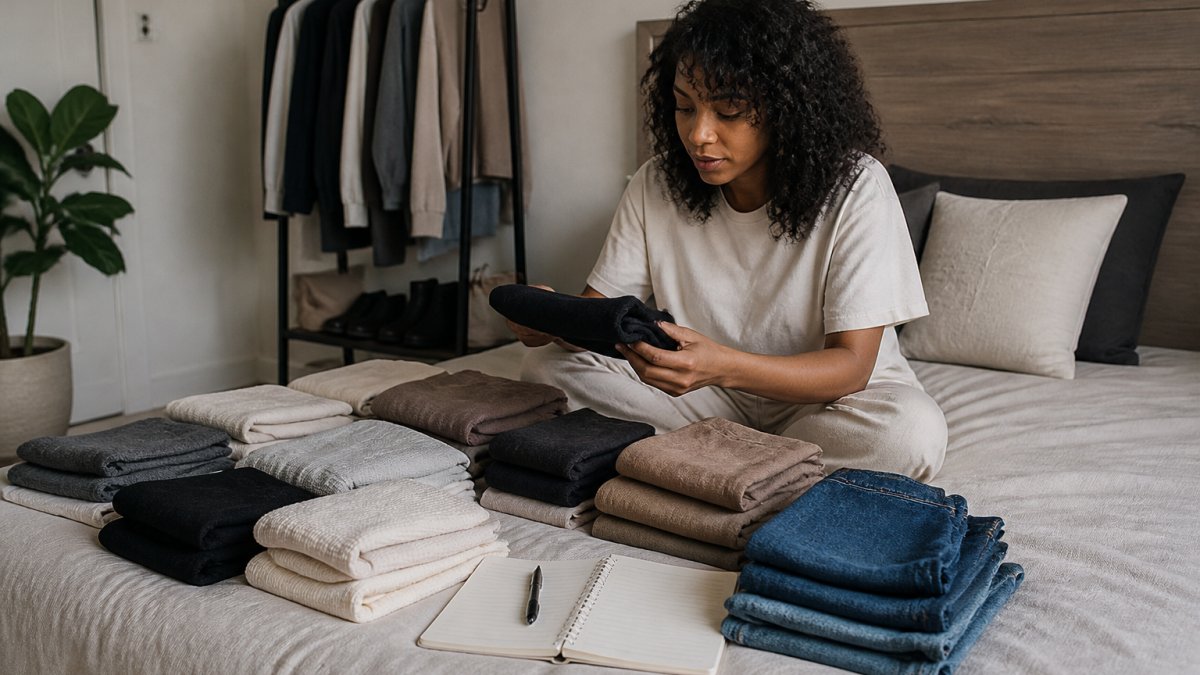
For each piece ask: Do I reach for this regularly? Does it fit well right now? Is it in good condition?
Keep only clear yeses; donate, sell, or recycle the rest.
Next, define your personal style from the pieces you kept: dominant colors, favored silhouettes, minimalist versus statement leanings.
Step 2: Choose Capsule Wardrobe Essentials That Work for Your Lifestyle
Not every capsule wardrobe looks the same. A corporate professional needs different essentials than someone who works from home.
Start with basics that form the foundation of any sustainable luxury capsule wardrobe:
- White and black t-shirts (quality cotton or organic blends)
- Well-fitting jeans (at least one neutral wash)
- Neutral trousers or tailored pants
Then add pieces specific to your life: statement and layering pieces for creative fields, quality tailoring for corporate jobs, functional pieces for active lifestyles.
Think in layers: base layers form your foundation, middle layers add depth, outer layers define your silhouette, and finishing layers (accessories, shoes, jewelry) transform outfits.
A common mistake is buying too many variations of the same item.
Step 3: Select Ethical Clothing Brands and Verify Sustainability Claims
This step separates genuine sustainable luxury from greenwashing. What follows is a practical 20-minute verification workflow for any brand, plus the luxury-specific quality checks that determine whether a piece will last long enough to justify its price.
Build a five-part evidence file for each brand
Treat every candidate brand like a small research project. Capture five categories of evidence; if a brand can't fill at least three with specifics, treat it as unverified regardless of marketing.
- Material disclosure. Can you find the fiber content and, ideally, its origin? "100% organic cotton" is a start; "organic cotton from a named supplier or region" is stronger. For wool, look for named mills or traceable farm programs. For cashmere, ask whether the brand discloses herd-management or grazing practices, since overgrazing is a well-documented risk in cashmere supply chains.
- Certification specifics. Certifications are only useful if you know what they cover. Common ones in premium apparel:
- GOTS: covers organic fiber content plus processing and social criteria for textile workers. It applies to specific products, not the whole brand.
- OEKO-TEX Standard 100: tests finished articles for harmful substances. It says nothing about organic farming or labor conditions.
- bluesign: focuses on resource efficiency and chemical safety in textile production, primarily for synthetics and finishes.
- Fair Trade Certified (apparel): addresses worker empowerment and premiums in specific factories, not the entire supply chain.
- B Corp: a whole-company governance and impact certification. Useful as a signal of accountability, but it does not certify any individual garment's materials or labor.
- Leather Working Group: relevant for leather footwear and bags; audits tanneries on environmental management. A brand displaying a certification logo should be able to say which products and facilities it covers. If the logo is a general badge with no product-level detail, discount it.
- Supply-chain transparency. Look for a supplier list, a factory map, or an annual sustainability report with named tiers. Tier 1 (final assembly) disclosure is now common; Tier 2 (fabric and trim suppliers) is a stronger signal. Full Tier 3 (raw material) disclosure is rare and worth noting when present.
- Labor evidence. Beyond a code of conduct, look for whether the brand audits factories, how often, whether audit summaries are published, and whether it participates in worker grievance mechanisms. A code of conduct alone is a promise; an audit program with published findings is evidence.
- Durability and repairability commitments. Does the brand offer repairs, replacement buttons or hardware, resoling, or a resale or take-back program? A brand that stands behind a garment for years is signaling that it expects the piece to last.
Run the greenwashing red-flag test
Certain phrases are marketing, not evidence. Treat them as prompts to dig deeper:
- "Eco-conscious," "planet-friendly," "responsibly made," and "sustainable collection" without a defined standard or metric.
- A single certification logo used across an entire site with no product-level mapping.
- Sustainability pages that describe goals and pledges but publish no current numbers or baselines.
A useful rule: if a claim cannot be checked against a named standard, a named supplier, or a published report, file it as unverified.
Layer in luxury-specific quality checks
Sustainability in luxury is inseparable from longevity, so verify construction alongside claims:
- Fabric weight and hand. Ask for grams per square meter (GSM) on knits and wovens when shopping online, or feel the fabric in person. A substantial jersey or flannel survives more washes than a thin one. Heavier is not always better, but flimsiness is a durability warning.
- Seam and stitch construction. Look for dense, even stitching; reinforced stress points at pockets, armholes, and crotch seams; and seam finishes appropriate to the fabric (French seams on lightweight silks, flat-felled seams on denim and shirting).
- Full versus fused interlining. In tailored jackets, a full or half canvas construction molds to the body and lasts far longer than a fused (glued) front, which can bubble or delaminate over time. Ask the brand directly; a serious tailoring house will know.
Compare cost per wear before you commit
A luxury piece earns its price through use. Estimate cost per wear before purchase:
Cost per wear = purchase price ÷ estimated number of wears
Estimate honestly based on your lifestyle, not your aspirations. A $450 blazer worn twice a week for a 40-week working year is roughly 80 wears in year one, about $5.63 per wear, falling further in later years. A $180 trend piece worn six times is $30 per wear. The comparison is the price divided by realistic use, not the sticker price.
Step 4: Build Your Color Palette and Mix-and-Match Strategy
Your color palette is the backbone of a functional sustainable luxury capsule wardrobe: when every piece works with every other, you maximize combinations from minimal items. The luxury-specific challenge is protecting your budget and the longevity of expensive pieces, a color mistake in a $700 coat is far costlier than in a fast-fashion jacket.
Choose neutrals with an eye on fabric and finish
Pick two to three neutral base colors that flatter your skin tone, black, white, gray, beige, navy, brown. In luxury pieces, fabric and finish matter as much as shade:
- Black reads differently in matte wool, crisp cotton, and shiny silk. Mixing matte and subtle sheen adds depth without adding color.
- White and cream show wear fastest. Choose weights and weaves that resist transparency and pilling, and expect to replace white basics sooner than dark ones. Factor that into cost per wear.
- Navy and charcoal are forgiving of minor wear and photograph well, making them strong anchors for tailoring and knitwear.
A practical rule for luxury: choose neutrals that hide the kind of wear your lifestyle produces. If you commute and carry a bag on one shoulder, a light-colored shoulder area will show abrasion; a darker or textured neutral will age more gracefully.
Add accents with a two-to-three rule
Add two to three accent colors that complement your neutrals and skin tone, keeping undertones consistent. Accents deliver the most visual variety per dollar, so concentrate them in lower-cost or high-impact pieces, knitwear, scarves, shirts, accessories, rather than outerwear and tailoring, which are expensive to replace if a trend fades.
Do the outfit math before you buy
A capsule works when the number of viable combinations is high relative to the number of pieces. Before adding a piece, test it against what you already own:
- Lay the candidate next to your three most-worn tops, bottoms, and outer layers.
- Count how many complete outfits you can build with it. A useful threshold is at least three new combinations with pieces you already own.
- If it only works with one item, it is a one-outfit purchase. That is fine for a statement piece, but it should be priced and justified accordingly.
This test matters most for luxury purchases: a $900 coat that only works with one outfit is a very expensive single look; the same coat that works with five outfits is a workhorse.
Test the palette in daylight and across seasons
Lay pieces out together in natural light, not just store lighting. If something clashes, either the piece doesn't belong in your wardrobe or your palette needs adjustment.
Document your palette with photos of key pieces and note specific shades, plus fabric and finish, so you can judge whether a new piece will sit alongside them convincingly.
Seasonality works differently in a luxury capsule.
Sustainable Fabrics Guide: What to Look For in Quality Pieces
The fabric you choose determines how long a piece lasts and its environmental impact.
Natural fibers generally outperform synthetics for longevity:
- Organic cotton: Grown without synthetic pesticides; softer and more breathable than conventional cotton
- Linen: Extremely durable; becomes softer with washing; naturally temperature-regulating
- Wool: Insulating; naturally wrinkle-resistant; lasts decades with proper care
Sustainable alternatives offer similar performance:
- Tencel: Made from sustainably harvested wood pulp; feels like silk or cotton depending on weave
- Hemp: Durable, breathable, and requires minimal pesticides to grow
- Recycled fibers: Made from reclaimed materials; reduces waste and resource consumption
Check fabric content labels: quality pieces typically use 100% natural fibers or intentional blends, so avoid mostly-polyester pieces unless designed for performance. Weight matters too, heavier fabrics generally last longer, and a thin cotton t-shirt won't survive as many washes as a substantial jersey knit. Ask about fabric treatments: wrinkle- and stain-resistant finishes can wear off and sometimes involve harmful substances, while untreated fabrics need more care but last longer and are safer for your skin.
How to Care for Clothes and Extend Garment Lifespan
How you treat your clothes determines how long they last.
Wash less frequently. Most items don't need washing after every wear.
Follow care labels religiously, they're instructions based on the fabric's needs.
Use cold water and gentle cycles. Hot water fades colors and weakens fibers.
Invest in proper storage. Hang items that wrinkle easily. Fold heavier knits to prevent stretching.
| Care Practice | Frequency | Impact |
|---|---|---|
| Spot cleaning instead of full wash | Every 2-3 wears | Extends lifespan by 50%+ |
| Air drying | Always when possible | Prevents fabric damage |
| Following care labels | Every wash | Preserves garment integrity |
| Addressing damage immediately | As needed | Prevents major repairs |
| Professional tailoring | 1-2 times per year | Keeps pieces looking new |
Frequently Asked Questions
How many pieces should a sustainable luxury capsule wardrobe have?
Most sustainable luxury capsule wardrobes contain 20 to 37 pieces, though the exact number depends on your lifestyle and climate. The key is quality over quantity: each piece should be versatile, well-made, and align with your personal style. Start with 20-25 core items and add layering pieces and seasonal pieces as needed. This range ensures you can create multiple outfit combinations without excess.
What makes an ethical clothing brand genuinely sustainable?
Ethical clothing brands prioritize transparency about their supply chain, use sustainable fabrics like organic cotton or recycled materials, pay fair wages, and minimize waste. Look for third-party certifications like Fair Trade, GOTS (Global Organic Textile Standard), or B Corp status. Ask brands directly about their manufacturing practices, material sourcing, and environmental impact. Avoid greenwashing by checking for concrete practices, not just marketing language.
How do I know which sustainable fabrics are best for a capsule wardrobe?
The best sustainable fabrics for a capsule wardrobe are durable, timeless, and low-impact. Organic cotton, linen, hemp, and recycled polyester are excellent choices. These fabrics age well, maintain their shape, and last longer with proper care. Avoid fast-fashion synthetics that pill and fade quickly. Check garment labels and ask brands about fiber content. Prioritize natural fibers for basics and layering pieces that you'll wear frequently.
What's the difference between a capsule wardrobe and just having fewer clothes?
A capsule wardrobe is intentional and strategic: every piece is chosen to mix and match, creating multiple outfits from a limited set. Simply having fewer clothes means less choice but no cohesion. A true capsule wardrobe features a unified color palette, versatile silhouettes, and pieces that work together. This intentional approach means you wear everything more often, get more value per garment, and reduce decision fatigue.