 how-to
How to Start a Luxury Minimalist Lifestyle
Table of Contents
- What Is a Luxury Minimalist and How It Differs from Ordinary Minimalism
- Step 1: Define Your Personal Values and Priorities
- Step 2: Declutter and Let Go of Unused Items
- Minimalist Wardrobe Essentials: Building a Curated Collection
- Step 3: Master Intentional Shopping and the 30/30 Rule
- Step 4: Organize Your Space and Create Negative Space
- Step 5: Adopt a Sustainable Approach to Consumption
- Step 6: Maintain Your Luxury Minimalist Lifestyle
- Frequently Asked Questions
Last Updated: October 13, 2026
What Is a Luxury Minimalist and How It Differs from Ordinary Minimalism
A luxury minimalist lifestyle combines intentional living with premium quality, curating possessions that matter and investing in items that last, not deprivation.
The key difference: ordinary minimalism prioritizes fewer items at any cost; luxury minimalism prioritizes fewer items that are exceptional, so what you own reflects your values.
Luxury minimalism also embraces negative space in your home and life.
Step 1: Define Your Personal Values and Priorities
Before you declutter or buy anything new, get clear on what matters to you.
Reflect on these questions:
- What brings you genuine happiness and fulfillment?
- What activities make you lose track of time?
- What do you want to be known for?
Write your answers without overthinking. Your values might include creativity, family, wellness, spiritual growth, learning, or adventure, whatever resonates is valid.
Once you know your values, use them as a filter: does this possession align with my values?
At 12:12, we believe that intentional living starts with knowing yourself.
Step 2: Declutter and Let Go of Unused Items
Decluttering is the bridge between your old life and your new one, and where many people get stuck emotionally.
For each item, ask yourself:
- Do I use this regularly?
- Does this bring me joy?
- Does this align with my values?
If you answer no to most of these, let it go. Donate it, sell it, or give it to someone who will use it.
The hardest part isn't deciding what to keep, it's releasing guilt about items you bought but never used.
Minimalist Wardrobe Essentials: Building a Curated Collection
A minimalist wardrobe means owning pieces that work together and reflect your style. Start with a color palette: 2-3 neutral bases (black, white, navy, gray, beige) and 1-2 accents. Everything you buy should fit within it.
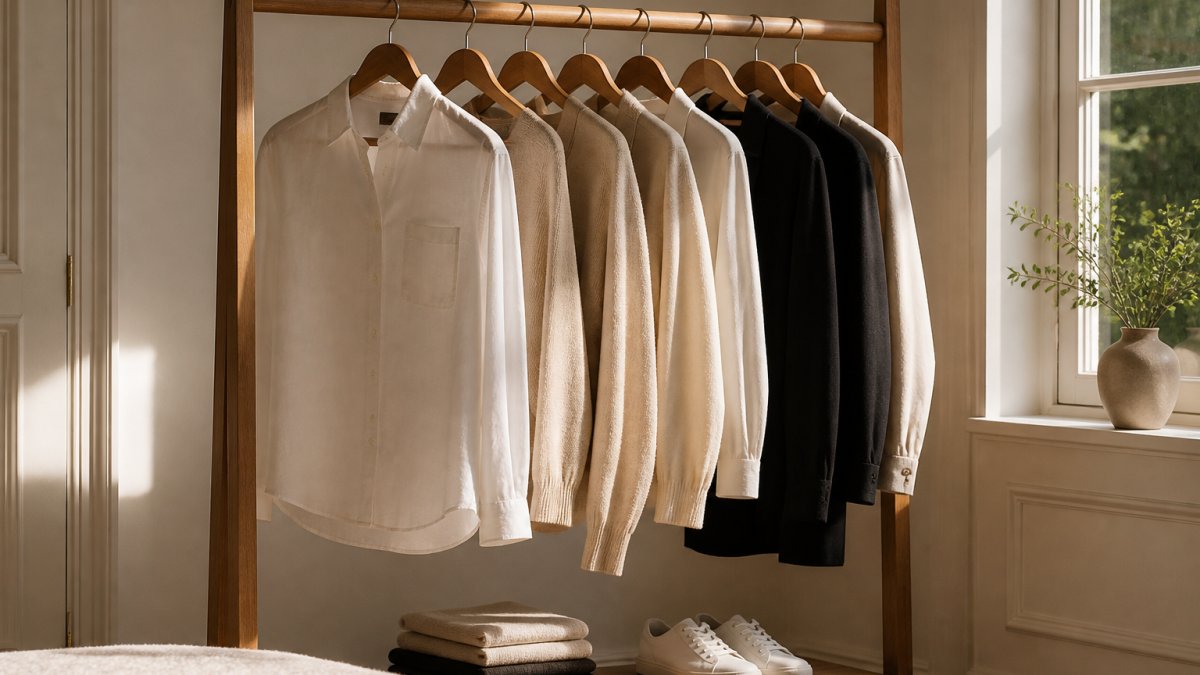
Your essentials depend on your lifestyle, but most people benefit from:
- White button-up shirt
- Neutral t-shirts (2-3)
- Well-fitting jeans
The goal isn't to own everything. It's to own versatile pieces that mix and match easily.
Invest in Timeless Pieces
Timeless pieces are the foundation of a luxury minimalist wardrobe. These are items that don't go out of style and work across multiple seasons and occasions.
Timeless means classic: a well-cut white button-up, perfectly fitted jeans, a neutral sweater in quality fabric. Invest in these and you wear them for years, unlike fast fashion that falls apart within months.
Prioritize Quality and Craftsmanship
Quality matters more than quantity in a luxury minimalist lifestyle. Look for natural fabrics (cotton, linen, wool, silk), tight even stitching, finished seams, and a reputation for durability. Quality costs more upfront but costs less per wear, a $50 shirt worn once costs more than a $200 shirt worn 200 times.
Step 3: Master Intentional Shopping and the 30/30 Rule
Intentional shopping means buying only what you truly need and want, preventing impulse purchases. Before buying anything, pause for at least 30 days: most impulse purchases fade within days; the ones that stay are worth considering.
The 30/30 Rule for Minimalists Explained
The 30/30 rule is simple: wait 30 days before buying, and only buy items you'll wear or use at least 30 times.
See something you like? Bookmark it instead of buying. Wait 30 days; if you still want it, ask: will you wear it at least 30 times? A $50 item worn 30 times costs about $1.67 per wear; worn three times, $16.67.
Step 4: Organize Your Space and Create Negative Space
Most guides stop at "leave some shelves empty" without saying where to start or how to keep it that way. Here's a room-by-room plan you can run in a weekend, plus storage mechanics that make negative space last.
The 20% Rule for Negative Space
Aim for roughly 20% of any storage surface to stay empty. Not 50%, that reads as unfinished. Not 5%, that reads as clutter. One-fifth empty is the breathing room most people find calm without feeling sparse.
Apply it to:
- Closet rod: if you can slide a hand between every hanger, you're close. If hangers touch, you're over.
- Bookshelf: leave the top shelf and one middle shelf partially open. Books should be able to lean without falling.
- Kitchen counters: only items used daily stay out. Everything else lives in a cabinet, even if it's pretty.
Room-by-Room Sequence (One Weekend)
Work in this order; each room takes 60-90 minutes. Don't skip ahead, each room feeds the next.
Saturday morning, Bedroom (90 min)
- Empty the closet rod onto the bed.
- Return only what you wore in the last 12 months (allow a separate bin for true seasonal items in four-season climates).
- Flip every hanger backward when you return an item; in six months, anything still backward is a candidate to leave.
- Count what's left. A common target is 30-50 hanging pieces, not counting underwear, socks, and workout wear.
Saturday afternoon, Kitchen (90 min)
- Pull everything off the counters.
- Group by function: cooking, prepping, serving, cleaning.
- Keep only cooking and prepping tools used in the last 30 days on the counter; everything else goes in a drawer or cabinet.
- Designate one "landing zone", a drawer or tray, for keys, mail, and chargers. Without one, they will spread.
Sunday morning, Living room (60 min)
- Remove every decorative object from surfaces.
- Add back one object per surface, maximum, a coffee table gets one item, not five.
- Route cables behind furniture or into a single management sleeve.
- Furniture that doesn't hold, seat, or display something you use is a candidate to leave.
Sunday afternoon, Bathroom and entryway (60 min)
- Bathroom: one product per category visible. Everything else in a cabinet or bin.
- Entryway: one hook per person, one shoe pair per person, one tray for keys and mail.
- If your entryway has no hook or tray, install one. Negative space fails when there's nowhere for daily items to land.
Storage Mechanics That Keep Negative Space Stable
Empty space collapses when items have no home. Three rules fix that:
- One category, one home. Batteries in one drawer, chargers in one bin. If you have to think about where something goes, it ends up on a surface.
- Containers set the limit. A sock bin holds what it holds; when full, something leaves.
- Vertical before horizontal. Stacking creates hidden piles; hanging or drawer dividers keep items visible, making negative space feel intentional.
What to Do When You Live With Others
Negative space is hardest in shared homes. Two adjustments help:
- Give each person one "free zone", a drawer, shelf, or corner, where their standards don't apply; the rest of the home follows the shared rule.
- Agree on a weekly 15-minute reset rather than a monthly deep clean.
Renters and Small Spaces
If you can't drill, patch, or remodel, negative space still works. Use freestanding shelving with open backs, lean art instead of hanging it, and choose furniture with legs so floor space reads as continuous. A 400-square-foot studio can feel as calm as a larger home when surfaces stay clear and storage stays vertical.
Step 5: Adopt a Sustainable Approach to Consumption
Sustainability in a luxury minimalist lifestyle isn't a slogan, it's a math problem: what does this item cost per use, and what happens to it when I'm done?
The Cost-Per-Use Framework
Cost per use (CPW) is the single most useful number in intentional consumption. The formula is simple:
Purchase price ÷ number of times you actually wear or use the item = cost per use
A few worked examples using common price points:
| Item | Price | Realistic uses | Cost per use |
|---|---|---|---|
| Fast-fashion t-shirt | $15 | 15 | $1.00 |
| Mid-tier t-shirt | $45 | 80 | $0.56 |
| Premium t-shirt | $120 | 300 | $0.40 |
| Fast-fashion blazer | $80 | 10 | $8.00 |
| Tailored blazer | $400 | 150 | $2.67 |
| Cheap sneakers | $60 | 40 | $1.50 |
| Quality leather sneakers | $180 | 400 | $0.45 |
The pattern is consistent: cheaper items often cost more per wear because they fail or fade faster. Two cautions: use count must be honest (a premium blazer worn twice a year has a CPW of $200, not $2.67, buy for the life you actually live), and CPW ignores resale value, which lowers it further.
A Realistic Budget for Building a Curated Wardrobe
You don't need to replace everything at once. Set an annual clothing budget and allocate by category rather than season. A workable split for rebuilding over 12-24 months:
- Footwear: 20-25%. Shoes take the most wear and are hardest to repair cheaply.
- Outerwear: 15-20%. One good coat can last a decade.
- Tops and knitwear: 20-25%. Highest turnover, so buy fewer but better.
Set the total first, then divide. A $1,200 annual budget is roughly $100 a month; one $300 coat in month three means two months of nothing else.
Purchase Criteria Before You Buy
Before any purchase above your "no-thought" threshold (commonly $50-$100), run this checklist:
- Fabric or material. Natural fibers, cotton, linen, wool, silk, leather, age better than synthetics. Check the tag, not the marketing.
- Construction. Even stitching, finished seams, reinforced stress points (pockets, buttonholes, hems), solid hardware.
- Repairability. Can a tailor alter it? A cobbler resole it? If not, it's disposable by design.
- Resale demand. If similar items sell on resale platforms, you have an exit; if not, you're committed for the item's full life.
- Fit with your wardrobe. Can you build at least three outfits around it using what you own? If not, it's an orphan piece.
Repair, Maintenance, and Resale
Sustainability isn't just about buying well. It's about keeping what you own in circulation.
Repair economics. A cobbler resole costs a fraction of new quality shoes and extends their life by years; a tailor can alter a jacket or replace a zipper for far less than replacement.
Maintenance habits that extend life:
- Rotate shoes and let them rest 24 hours between wears, this alone can double their lifespan.
- Wash less; most garments don't need washing after every wear. Spot-clean and air out instead.
- Store knitwear folded, not hung, to prevent shoulder stretch.
Resale and donation paths:
- Resale platforms suit recognizable brands in good condition. Photograph in natural light, disclose flaws, price to sell rather than maximize.
- Consignment takes a cut but handles logistics, best for higher-value pieces.
- Donation is the fallback for worn but functional items. Check the organization distributes rather than discards.
Secondhand first. For furniture, books, kitchen tools, and some outerwear, secondhand often gets you a higher-quality item at a lower price than buying new.
Where Luxury Minimalism Diverges
Ordinary minimalism treats sustainability as "buy less." Luxury minimalism treats it as "buy once, maintain well, keep in circulation", paying more upfront because the math works over time. That's the loop: fewer purchases, higher quality, longer ownership, active repair, and a clear exit through resale or recycling.
Federal Trade Commission guidance on textile and environmental marketing claims
Step 6: Maintain Your Luxury Minimalist Lifestyle
Starting a luxury minimalist lifestyle is one thing; maintaining it is another. Without intentional habits, you'll drift back into old patterns. Create these:
- Monthly review: Spend 15 minutes reviewing your possessions and notice anything new that doesn't fit your values.
- One in, one out: When you buy something new, remove something old to keep your total stable.
- Quarterly closet audit: Every three months, remove pieces you aren't wearing or that don't make you feel good.
The luxury minimalist lifestyle isn't about perfection, it's about intentional choices that support your wellbeing and values.
| Maintenance Practice | Frequency | Purpose |
|---|---|---|
| Monthly review | Once per month | Catch new clutter early |
| One in, one out | With each purchase | Keep possessions stable |
| Closet audit | Every 3 months | Ensure items serve you |
| Values check | Annually | Stay aligned with priorities |
Starting a luxury minimalist lifestyle is an investment in yourself. It requires intention, patience, and honest reflection, but the reward is a life aligned with your values.
At 12:12, we support this journey through premium, minimalist luxury streetwear designed for intentional living.
Frequently Asked Questions
What is the 30/30 rule for minimalists?
The 30/30 rule is a guideline to help you make intentional purchases. It encourages you to wait 30 days before buying an item and then only purchase it if you intend to wear or use it at least 30 times. This principle helps you evaluate whether pieces truly serve your lifestyle, encouraging you to keep only versatile, functional pieces that align with your personal style and daily activities.
How do I know if something is worth keeping when decluttering?
Ask yourself three questions: Does this item align with my current values and lifestyle? Will I actually use this in the next year? Does it make me feel good when I see or wear it? Keep items that meet at least two of these criteria. For clothing specifically, consider cost-per-use: divide the price by how many times you've worn it. Items with high cost-per-use justify keeping; those you rarely wear should go. Donate or resell pieces in good condition rather than discarding them.
Can you live a luxury minimalist lifestyle on a budget?
Yes. Luxury minimalism is about quality and intentionality, not spending more overall. Buy fewer items but choose pieces that last longer, fit better, and bring genuine joy. Invest in basics and timeless essentials, then add one or two statement pieces that reflect your personal values. Shop secondhand for luxury items, repair and maintain what you own, and avoid impulse purchases. This approach often costs less than buying cheap items frequently, since durable pieces have lower long-term cost-per-use.
How can wearable affirmations like spiritual apparel support my minimalist lifestyle?
Intentional clothing serves as a daily reminder of your values and priorities, making it easier to stay aligned with your minimalist goals. When you choose pieces with meaning, whether spiritual symbols, affirmations, or designs that resonate with your beliefs, you're more likely to wear them regularly and less likely to make impulse purchases that clutter your life. Quality, meaningful pieces become investment items you actually use, reducing waste and supporting the core minimalist principle of owning only what truly matters to you.