 ultimate-guide
Why Wear Minimalist Clothing for Spiritual Growth
Table of Contents
- The Spiritual Meaning of Clothing: What Your Wardrobe Says About Your Inner State
- How Minimalist Clothing Reduces Distraction and Supports Focus
- The 3-3-3 Rule for Clothes: A Simple Framework for Intentional Dressing
- Minimalist Wardrobe Benefits for Spiritual Practice and Daily Life
- Mindful Fashion: Choosing Clothing That Reflects Your Personal Values
- How to Build a Minimalist Wardrobe for Spiritual Growth: A Step-by-Step Guide
- What Minimalist Clothing Can and Cannot Do for Spiritual Growth
- Conclusion: Dressing with Intention, Living with Purpose
- Frequently Asked Questions
Last Updated: October 7, 2026
The Spiritual Meaning of Clothing: What Your Wardrobe Says About Your Inner State
The spiritual meaning of clothing is the idea that what you wear reflects and reinforces your inner state, not just your outer appearance. A cluttered closet often mirrors a cluttered mind.
This guide from 12:12 explores why minimalist clothing for spiritual growth has become a meaningful practice for people who want their daily habits to match their inner intentions.
But there is a catch most guides skip. Clothing can support a spiritual practice. It cannot replace one.
Clothing as a Reflection of Values and Identity
What you wear is a values statement, whether you intend it or not. Choosing secondhand over fast fashion signals something. So does wearing a single well-made piece for years instead of cycling through trends.
Many people find that their wardrobe choices quietly reveal what they actually prioritize: comfort, status, faith, creativity, or speed.
The reverse works too. Dressing with intention can nudge behavior. Put on clothing that feels calm and deliberate, and you tend to move through the day that way.
How Minimalist Clothing Reduces Distraction and Supports Focus
Minimalist clothing reduces distraction by removing the small decisions that drain attention before your day even starts. Fewer options mean fewer micro-choices, and fewer micro-choices leave more room for prayer, meditation, journaling, or simply being present.
The Psychology of Fewer Choices
Decision fatigue is real, and it compounds. Every "what do I wear" moment spends a little mental energy you could have spent elsewhere. A pared-down wardrobe turns that daily negotiation into a near-automatic act.
The practical effect is subtle but consistent. When getting dressed takes seconds instead of minutes, you arrive at your practice, your work, or your morning routine with more capacity. Simplicity of dress becomes a form of protection for your focus.
The 3-3-3 Rule for Clothes: A Simple Framework for Intentional Dressing
The 3-3-3 rule for clothes is a wardrobe constraint built around three groups of three. The most common version is three tops, three bottoms, and three pairs of shoes. A second version uses three colors, three layers, and three occasions.
Why a constraint works at all comes down to how habits form. A wardrobe that fits on one shelf removes the daily negotiation, and a removed negotiation becomes a stable routine.
How to Actually Run the 3-3-3 Rule
A workable sequence looks like this:
- Pick your three anchors. Choose three garments you reach for without thinking. These are your baseline, not your aspiration.
- Name your three contexts. Most people need clothing for daily life, movement or work, and something slightly dressier. Three contexts, not three moods.
- Set your three colors. One neutral base, one secondary neutral, one accent. Every piece should work with at least two of the three.
- Test the rotation. Wear only those pieces for two weeks. Note what you missed and what you never touched.
- Adjust once, then stop. Add or remove one or two items. Resist the urge to keep optimizing.
Where the Framework Breaks Down
The 3-3-3 rule is a starting constraint, not a universal law. It breaks in predictable ways:
- Climate. Four distinct seasons require layers, not fewer items. A three-top wardrobe in a cold-winter region is a recipe for discomfort, not simplicity.
- Work requirements. Dress codes, uniforms, and safety gear sit outside personal choice. A nurse, a tradesperson, and a remote worker cannot run the same count.
- Body changes. Pregnancy, weight shifts, and medical needs change what fits. A rigid number can become a source of shame rather than freedom.
- Sensory needs. Some people cannot tolerate certain fabrics, tags, or fits. Comfort is not optional for them, and the framework should bend accordingly.
A common pattern among people who stick with a small wardrobe is that they treat the number as a direction, not a rule. They land somewhere between fifteen and forty items depending on climate and work, and they stop counting once the routine feels automatic.
The Spiritual Point of the Constraint
The spiritual value of the 3-3-3 rule is not the number. It is the act of deciding in advance. Every time you choose a garment before you need it, you spend a small amount of attention on purpose instead of impulse.
That is the honest claim. The rule does not make you more spiritual. It removes a recurring decision so you have more room to show up for the practices that do.
Minimalist Wardrobe Benefits for Spiritual Practice and Daily Life
The benefits of a minimalist wardrobe fall into two buckets: practical and spiritual. Most guides blur them together. Keeping them separate is what makes the claims honest.
Practical Benefits You Can Actually Measure
These are the benefits that show up in a normal week:
- Less laundry. A smaller rotation means fewer loads, less folding, and less time spent on maintenance.
- Less storage. A wardrobe that fits in one closet or one dresser frees physical space, which in turn reduces visual noise in the room where you sleep or pray.
- Faster mornings. Getting dressed in under a minute is common once the palette is set and every piece works together.
- Lower spend over time. Buying fewer, better pieces usually costs less per year than replacing cheap items every season, though the upfront cost per item is higher.
- Easier packing and travel. A coordinated palette makes a week-long trip fit in a carry-on.
These are the benefits you can point to without overclaiming. They are real, and they compound.
Spiritual Benefits and Their Honest Limits
The spiritual benefits are real too, but they are indirect. A calmer room supports a calmer start. A calmer start makes it easier to sit down for prayer, meditation, breathwork, or journaling.
What minimalist clothing can do:
- Reduce decision fatigue so attention is available for practice
- Create a visual environment that supports stillness
- Serve as a daily reminder of an intention you set
- Align outward habits with inward commitments
What it cannot do:
- Generate spiritual growth on its own
- Substitute for prayer, meditation, service, or reflection
- Guarantee a particular emotional or energetic state
- Override grief, illness, or circumstance
Traditions differ on how much appearance matters. Some emphasize modesty and simplicity of dress as a discipline. Others treat clothing as largely incidental to the inner life. A few frame dress as a form of devotion.
The Mechanism, Stated Plainly
The mechanism is attention, not magic. Every decision you remove from your morning is attention you can redirect. Every object you remove from your space is visual input your brain no longer processes. Minimalist clothing works because it reduces load, and reduced load makes room for practice. That is the whole mechanism, and it is enough.
777 Essential Oversized Boxy Fit Cozy Spiritual Hoodie →
A Note on Different Bodies and Different Lives
Benefits vary by person. Someone with sensory sensitivities may find a small, soft, tag-free wardrobe genuinely transformative. Someone in a cold climate may find that a larger wardrobe of layers is what actually reduces daily friction.
The honest version of this section is that minimalist clothing helps most when it fits your actual body, budget, climate, and work. When it does not fit those things, it becomes another source of stress, which is the opposite of the point.
Mindful Fashion: Choosing Clothing That Reflects Your Personal Values
Mindful fashion is the practice of choosing clothing based on your values rather than impulse, trends, or pressure.
Start by naming three values you want your wardrobe to express. Common ones include simplicity, sustainability, modesty, and comfort. Then test each purchase against them.
- Does this piece fit at least two of my values?
- Will I wear it at least once a week?
- Does it work with what I already own?
Mindful consumption also means sitting with a purchase before making it. A short waiting period filters out most impulse buys, and the pieces that survive the wait tend to stay in rotation far longer.
How to Build a Minimalist Wardrobe for Spiritual Growth: A Step-by-Step Guide
Step 1: Empty and sort. Pull everything out. Make three piles: keep, donate, and undecided.
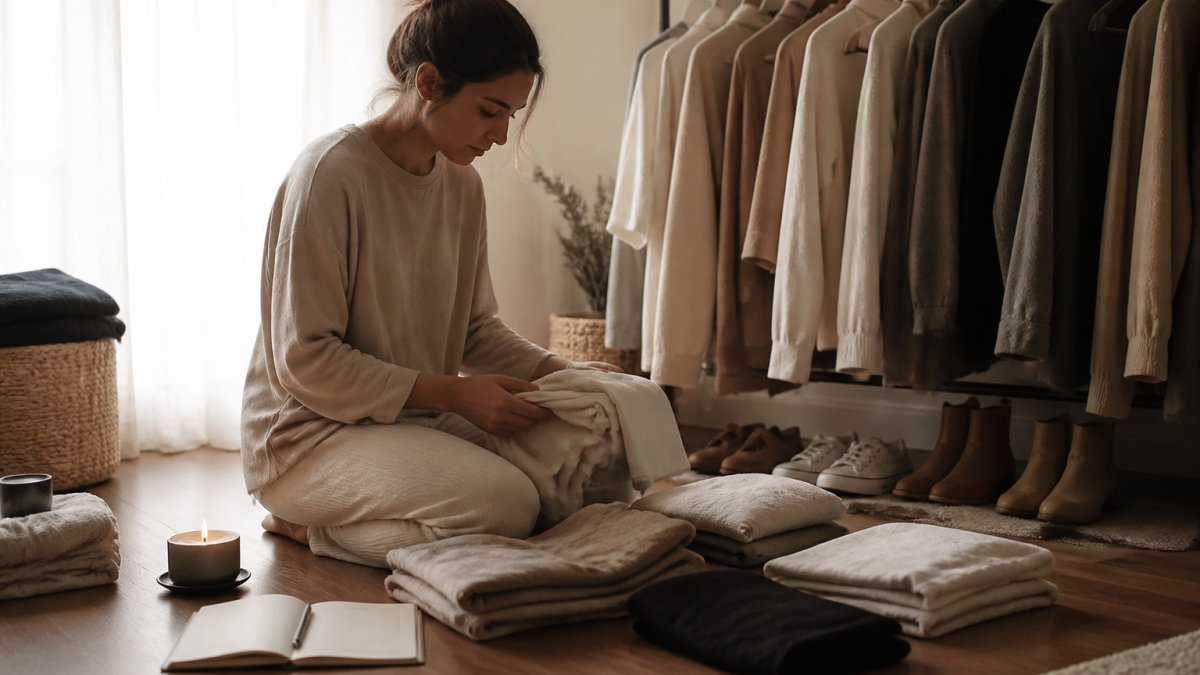
Step 2: Define your palette. Pick two or three colors that work together.
Step 3: Set your numbers. Use the 3-3-3 rule as a starting point, then adjust for climate and work.
Step 4: Fill the gaps deliberately. Replace only what is missing. One well-made piece beats five cheap ones.
Step 5: Revisit monthly. A quick monthly review keeps the wardrobe honest and prevents drift.
Accessibility, Budget, and Climate Considerations
A minimalist wardrobe should fit your actual life, not an idealized one.
Body inclusivity matters as well. The goal is clothing that fits you comfortably and lets you move without restriction, not clothing that fits a trend.
For those who want pieces that carry meaning, 12:12 offers minimalist luxury streetwear designed as wearable affirmations, including the Celestial 11:11 Oversized T-Shirt and the 777 Essential Oversized Hoodie.


What Minimalist Clothing Can and Cannot Do for Spiritual Growth
Minimalist clothing can reduce distraction, support focus, and make your daily habits more intentional. It cannot generate spiritual growth on its own.
That distinction matters. A small wardrobe is a tool, not a transformation.
There is also a limit to the claims worth making. Traditions differ on how much appearance matters, and practices vary widely across faiths and philosophies.
What holds up across traditions is the principle of intentionality: choosing deliberately, owning less, and letting your outward habits reflect your inward commitments.
Conclusion: Dressing with Intention, Living with Purpose
The challenge is not finding minimalist clothing. It is keeping your wardrobe aligned with your values once the initial motivation fades.
At 12:12, we design premium, minimalist luxury streetwear meant to be worn as a daily reminder of your intentions. Our celestial tees and hoodies blend spiritual significance with quality construction, and every order over $50 ships free.
If you want clothing that supports the life you are building, shop the collection and start dressing with intention.
Frequently Asked Questions
What type of clothes do spiritual people wear?
Spiritual people often choose clothing that feels intentional and comfortable, such as breathable fabrics, neutral or meaningful colors, and simple silhouettes. Many prioritize modesty, ease of movement, and pieces that carry personal significance, like angel number apparel. The goal is not a uniform but a wardrobe that supports mindfulness, reduces distraction, and reflects inner values. Minimalist clothing helps because it removes excess decision-making and keeps focus on spiritual practice.
What is the 3-3-3 rule for clothes?
The 3-3-3 rule is a minimalist wardrobe guideline: choose 3 tops, 3 bottoms, and 3 pairs of shoes (or 3 categories of accessories) that mix and match easily. Some versions suggest 3 weeks of clothing, 3 colors, or 3 occasions. The exact numbers vary, but the principle is the same: limit your options to what you actually wear, so getting dressed becomes quick and intentional. It reduces decision fatigue and helps you focus on what matters beyond appearance.
Can a minimalist wardrobe support spiritual growth?
Yes, a minimalist wardrobe can support spiritual growth by reducing mental clutter and decision fatigue. When you own fewer, more intentional pieces, you spend less time and energy on what to wear and more on prayer, meditation, or service. Minimalist clothing also encourages mindful consumption, helping you detach from consumerism and align purchases with personal values. However, the wardrobe itself is a tool, not a guarantee; spiritual growth still requires practice, reflection, and community.
How can I dress more intentionally?
Start by defining your values: comfort, modesty, sustainability, or spiritual symbolism. Then audit your wardrobe and remove anything that does not fit those values or that you never wear. Choose fabrics that feel good and allow ease of movement, like cotton or fleece. Limit your color palette and silhouettes to simplify choices. Finally, consider adding one or two pieces that carry personal meaning, such as a 12:12 angel number tee or hoodie, to serve as a wearable reminder of your intentions throughout the day.