 blog
Eco-Friendly Streetwear Alternatives to Polyester
Table of Contents
- Why Polyester Dominates Streetwear (and Why You Might Want Something Different)
- Organic Cotton vs Polyester: The Natural Fiber Case
- Hemp Clothing Benefits for Sustainable Streetwear
- Recycled Polyester Pros and Cons: Is It Actually Better?
- TENCEL™ Lyocell Clothing: The Performance Alternative
- Blends and Real-World Trade-Offs for Streetwear Durability
- How to Evaluate Eco-Friendly Streetwear: What Actually Matters
- Frequently Asked Questions
Last Updated: October 17, 2026
Why Polyester Dominates Streetwear (and Why You Might Want Something Different)
Polyester is everywhere in streetwear for one simple reason: it works. It's cheap to produce, durable, resists wrinkles, and dries fast. For brands chasing margins and consumers wanting low-maintenance pieces, conventional polyester has been the default for decades. But that dominance is starting to crack.
The problem isn't polyester itself, it's what comes with it. Microfiber shedding during washing releases microplastics into waterways. Production requires significant energy and relies on fossil fuels. And once a polyester garment hits a landfill, it can take 200 years to decompose. For anyone building a wardrobe that actually aligns with their values, the disconnect between wearing intentional fashion and wearing material designed to persist forever in the environment becomes harder to ignore.
Eco-friendly streetwear alternatives to polyester exist, and they're not all compromise.
The real question isn't whether alternatives exist. It's which ones actually deliver on durability, comfort, and performance while reducing environmental impact. Some alternatives fall apart after a few washes. Others cost three times as much for marginal benefits. The gap between marketing claims and real-world performance is where most shoppers get stuck.
Organic Cotton vs Polyester: The Natural Fiber Case
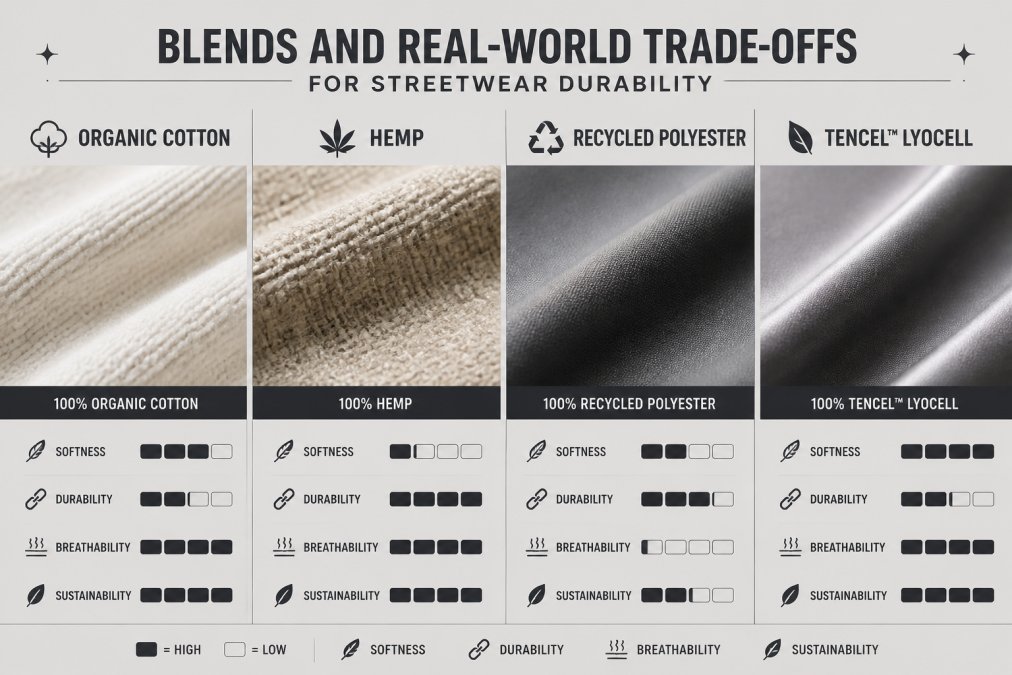
Organic cotton is the most straightforward alternative to polyester. It's breathable, soft, and biodegradable, qualities that matter for everyday streetwear. Unlike conventional cotton, which relies heavily on pesticides, organic cotton uses natural farming methods that reduce chemical runoff and soil degradation.
The catch: organic cotton requires more water to grow than polyester requires energy to produce. A single organic cotton tee uses roughly 700 gallons of water from seed to finished garment. That's significant, especially in water-stressed regions. Organic cotton also wrinkles more easily than polyester, shrinks if you're not careful, and typically costs 20-40% more per piece.
For streetwear specifically, organic cotton shines in basics, tees, hoodies, lightweight layers. It breathes better than polyester on warm days and feels softer against skin. But it's less ideal for performance pieces or garments you'll wash frequently.
The real advantage of organic cotton over polyester isn't just environmental, it's comfort-driven. If you're wearing a piece regularly, the fabric feel matters as much as the impact story. Organic cotton wins there for most people.
Hemp Clothing Benefits for Sustainable Streetwear
Hemp is tougher than it sounds. Historically dismissed as a niche fabric, hemp clothing benefits from serious advantages that make it worth reconsidering for eco-friendly streetwear alternatives to polyester. Hemp requires minimal water, grows without pesticides, and regenerates soil rather than depleting it.
The durability case for hemp is compelling. Hemp fibers are stronger than cotton, meaning garments last longer and resist pilling better than polyester blends. Streetwear built from hemp can handle repeated wear and washing without degrading. The fabric also softens with age, unlike polyester, which can become brittle, or cotton, which can lose shape.
The downsides are real. Hemp has a stiffer hand feel initially, though this improves after a few washes. It wrinkles more than polyester. And pure hemp pieces tend to cost more upfront because production capacity is smaller than cotton or synthetic alternatives. Hemp clothing benefits emerge most clearly over years of ownership, not weeks.
For intentional fashion, pieces you plan to wear for years, hemp represents one of the strongest cases against polyester. The environmental footprint shrinks with every wash as the garment's lifespan extends.
Recycled Polyester Pros and Cons: Is It Actually Better?
This is where the conversation gets complicated. Recycled polyester pros and cons don't paint a simple picture. On the surface, recycled polyester seems like the perfect compromise: it diverts plastic from landfills, requires 30-40% less energy to produce than virgin polyester, and maintains the performance benefits of conventional polyester.
The problem is microfiber shedding. Recycled polyester sheds microplastics just like virgin polyester does. Every wash releases tiny synthetic fibers into waterways. The source material doesn't change this fundamental issue. You're not solving the microplastic problem by recycling the base material, you're just delaying the landfill timeline.
Recycled polyester pros include cost efficiency, durability, and performance. It works well for athletic wear and performance streetwear where durability matters more than breathability. It resists wrinkles and fades better than natural fibers. But the environmental benefit is overstated in marketing. Recycled polyester pros and cons ultimately balance toward "better than virgin polyester, but not a complete solution."
The honest take: recycled polyester is a stepping stone, not a destination. It's useful for pieces where performance is non-negotiable and alternatives don't work. But it's not the answer for someone serious about reducing environmental impact.
TENCEL™ Lyocell Clothing: The Performance Alternative
TENCEL™ lyocell is engineered to split the difference between natural feel and synthetic durability. Made from wood pulp processed through a closed-loop system, lyocell uses 99% of its solvents in a recycling process, meaning minimal chemical waste enters waterways. It biodegrades like natural fiber but handles moisture better than cotton.
TENCEL™ lyocell clothing performs well in streetwear applications. It breathes better than polyester, resists wrinkles better than cotton, and dries faster than both. The fabric is soft without feeling cheap. For someone building eco-friendly streetwear alternatives to polyester, lyocell represents one of the few materials that doesn't require compromising on everyday wearability.
The cost is higher than polyester but comparable to premium organic cotton. Durability is solid, not quite hemp-level longevity, but better than standard cotton. Lyocell also works well in blends, which we'll cover next.
The limitation: production capacity is smaller than polyester or cotton, so availability can be inconsistent. Some brands use lyocell heavily; others avoid it because supply chains are less established.
Blends and Real-World Trade-Offs for Streetwear Durability
Pure materials are cleaner stories, but blends are where real-world performance lives, and where most sustainability claims quietly fall apart. A 70% organic cotton / 30% recycled polyester fleece gives you cotton's hand feel with the shape retention and pill resistance of synthetic fiber.
The percentage is the first thing to read, because small synthetic shares change end-of-life options disproportionately. A garment with even 5% elastane or 10% polyester is generally harder to recycle mechanically than a mono-material piece, because the synthetic component can't be separated economically at most recycling facilities.
Streetwear garment types behave differently, so judge blends by category rather than by fiber alone:
- Heavyweight hoodies and fleece. A cotton-rich fleece (roughly 80/20 cotton-poly) holds shape and resists pilling better than 100% cotton, which can stretch at cuffs and hem. But brushed fleece backings shed more than flat knits, so wash cold, inside out, and less often. A 100% cotton loopback fleece avoids synthetic shedding entirely but may bag out faster at high wear.
- Tees and jersey basics. 100% organic cotton or hemp-cotton blends breathe best and stay compostable; a small polyester share improves wrinkle resistance and colorfastness but reduces breathability and recyclability. For a tee worn three or more times a week, a 90/10 cotton-elastane blend can outlast a pure cotton tee by holding its neckline and body shape, fewer replacements can outweigh the recycling downside.
- Outerwear and shells. Performance shells usually need a synthetic face fabric or membrane for weather resistance; there is no pure-natural equivalent that matches waterproof-breathable performance at streetwear price points. Here the practical move is durability and repairability, reinforced seams, replaceable zippers, and a cut that survives layering, rather than chasing a pure-fiber label.
- Active and training pieces. Stretch and moisture management typically require synthetics or elastane. A recycled-polyester blend with a tight knit reduces fiber release compared with loose, brushed constructions, and a longer lifespan offsets some of the shedding impact.
Construction matters as much as fiber content. A tightly knit, heavier-weight fabric with reinforced seams and a stable neckline will usually outlast a lighter pure-material piece, which means fewer replacements and less total waste. That is the honest math: a well-made blend worn for years can beat a poorly made "pure" garment worn for months.
The takeaway is not that blends are bad, it is that blends are practical compromises you should choose deliberately. Match the blend to the garment type and your wear pattern, read the percentage, and accept that a small synthetic share buys durability at the cost of cleaner recycling and composting. That transparency is worth more than a perfect-sounding fiber name.
How to Evaluate Eco-Friendly Streetwear: What Actually Matters
Most shoppers evaluate eco-friendly streetwear by reading the fiber name and stopping there. That is the wrong order.
1. Verify the claim, don't just read it. Look for documentation rather than adjectives.
2. Compare cost per wear, not sticker price. A $120 hemp hoodie worn twice a week for four years costs far less per wear than a $40 polyester hoodie replaced every year. Do the rough math: purchase price divided by estimated wears.
3. Weigh the full lifecycle. Production impact (water, energy, chemicals), use-phase impact (washing, drying, microfiber shedding), and end-of-life (recycling, composting, landfill) all count. A biodegradable natural fiber still has a production footprint; a recycled synthetic still sheds microfibers in the wash.
4. Match the material to the garment and your wear pattern. A statement tee worn a few times a month suits organic cotton or hemp. A performance hoodie for regular training or outdoor use may justify a durable recycled-synthetic blend.
The mistake most shoppers make is treating eco-friendly as a binary choice. It is not. You are evaluating degrees of impact and evidence quality, not choosing between "good" and "bad." A piece that lasts five years instead of two is usually better for the environment than a "sustainable" piece you replace annually, and a documented claim is worth more than a compelling one.
At 12:12, we believe intentional fashion means choosing pieces that align with both your values and your actual life. That sometimes means accepting blends. It always means choosing quality over quantity, durability over trends, and evidence over adjectives.
Frequently Asked Questions
What are the most eco-friendly alternatives to polyester for clothing?
Organic cotton, hemp, TENCEL™ lyocell, recycled polyester, and linen are the strongest alternatives. Organic cotton uses no synthetic pesticides; hemp requires minimal water and grows without chemicals. TENCEL™ lyocell is made from sustainably managed wood pulp with a closed-loop production process. Recycled polyester diverts post-consumer waste from landfills. Each has trade-offs: organic cotton requires more land, hemp can feel coarse, and recycled polyester still sheds microfibers. The best choice depends on your priority, environmental impact, durability, comfort, or cost.
Is organic cotton more sustainable than polyester?
Organic cotton avoids synthetic pesticides and uses less energy to produce than conventional cotton, making it better than conventional alternatives. However, it requires significantly more water and land per garment than polyester. Polyester's main advantage is resource efficiency; its drawback is that it's petroleum-based and takes 200+ years to biodegrade. For streetwear, organic cotton works well if durability and care reduce the number of replacements you need over time, offsetting its higher resource footprint per unit.
Is recycled polyester actually eco-friendly?
Recycled polyester diverts plastic waste from landfills and requires less energy than virgin polyester production, making it genuinely better than conventional polyester. The catch: it still sheds microfibers when washed, contributing to microplastic pollution in water systems. It also cannot be recycled infinitely, quality degrades with each cycle. For streetwear, recycled polyester is a pragmatic middle ground if you wash garments infrequently, use microfiber-catching filters, or prioritize keeping textiles out of landfills over perfect biodegradability.
How can I tell if a streetwear brand uses sustainable materials?
Look for third-party certifications: Global Organic Textile Standard (GOTS) for organic cotton, Fair Trade Certified, or Cradle to Cradle for recycled content. Check the brand's supply chain transparency, legitimate brands disclose where and how fibers are sourced. Review customer testimonials about durability and garment longevity; a piece worn for years reduces the environmental cost per wear. Beware of vague claims like 'eco-friendly' without certification. Premium brands often provide material breakdowns and care instructions that signal quality and intentionality in production.