 ultimate-guide
Why Heavy Cotton Is Better for Streetwear Silhouettes
Last Updated: October 22, 2026
Quick Summary
Why heavy cotton is better for streetwear silhouettes is because it holds structure, resists stretching, and maintains the intentional shape you want through repeated wear. Heavyweight fabrics above 200 GSM keep oversized fits from collapsing, develop character over time, and hold dye and prints more evenly than lighter alternatives.
- Heavyweight cotton above 200 GSM has nearly twice the fiber density of 150 GSM fabric, creating tighter weaves that resist pilling and shape loss.
- Lightweight shirts show wear within 20-30 washes while heavyweight versions sustain 50+ washes before visible fading or thinning.
- An oversized heavyweight tee that shrinks 2-3% stays oversized, while a lightweight version that stretches 5-8% shifts from intentional to accidentally droopy.
- A loosely knit heavyweight cotton breathes better than a tightly knit lightweight one, making heavier fabrics viable in warm climates with light colors and loose fits.
- Heavier fabric protects prints by keeping water-based and discharge designs from bleeding and resists the pilling that dulls graphics after a season.
Table of Contents
- What Heavyweight Cotton Means for Streetwear
- Fabric Weight and GSM Explained
- Heavyweight vs Lightweight T-Shirts: How Structure Changes Everything
- Shape Retention and Dimensional Stability
- T-Shirt Fabric Weight Guide for Your Needs
- How to Style Heavyweight T-Shirts for Maximum Impact
- Cotton T-Shirts for Hot Weather: Weight vs Breathability
- The Trade-Offs: When Heavy Cotton Isn't the Answer
- Frequently Asked Questions
What Heavyweight Cotton Means for Streetwear
Understanding why heavy cotton is better for streetwear silhouettes, because it holds structure, resists stretching, and maintains the intentional shape you want, matters for every piece you buy.
At 12:12, we design our celestial tees in premium heavyweight cotton because the fabric supports the spiritual intention behind each piece.
The distinction isn't just aesthetic. Heavyweight fabrics behave differently under stress, hold dye more evenly, and develop character over time rather than falling apart.
Fabric Weight and GSM Explained
Fabric weight measures how much a piece of cotton weighs per unit area, typically expressed in GSM (grams per square meter).
Lightweight cottons sit between 120-150 GSM, midweight between 150-200 GSM, and heavyweight above 200 GSM.
Higher GSM means tighter weaves and denser yarn: better opacity, stronger resistance to pilling, and fabric that holds its shape instead of stretching out.
Construction matters too: a tightly knit heavyweight outperforms a loosely knit one at the same weight, so GSM is only the starting point.
Heavyweight vs Lightweight T-Shirts: How Structure Changes Everything
The practical differences go beyond feel.
This is why heavy cotton is better for streetwear silhouettes: for oversized fits, heavyweight cotton is the right choice.
The visual difference shows immediately: heavy cotton photographs sharper, holds its form in motion, and reads as more intentional. That's why vintage-washed heavyweight tees are the premium streetwear standard.
Durability separates the two as well. Lightweight shirts show wear within 20-30 washes; heavyweight versions sustain 50+ washes before visible fading or thinning.
Shape Retention and Dimensional Stability
Shape retention is where heavyweight cotton proves its value.
Dimensional stability refers to how much a fabric shrinks or stretches over time.
Oversized fits depend on this stability. An oversized heavyweight tee that shrinks 2-3% is still oversized; a lightweight version that stretches 5-8% shifts from intentionally oversized to accidentally droopy.
Vintage-washed heavyweight cottons add stability because the wash is applied before construction, locking in dimensions so the fabric won't shift dramatically at home.
T-Shirt Fabric Weight Guide for Your Needs
A useful fabric weight guide translates GSM into what you'll actually see on your body: how the shoulder sits, whether the hem breaks, how the collar behaves after ten washes, and whether the piece works in your climate. Use the ranges below as a starting point, then adjust for knit structure, yarn quality, and finish.
| GSM range | What it feels like | Silhouette behavior | Best use | Watch-outs |
|---|---|---|---|---|
| 120-150 | Thin, fluid, slightly sheer in light colors | Clings at the chest, collapses at the hem, drapes close to the body | Hot-weather layering, undershirts, travel | Shows collar stretch early; poor opacity in white |
| 150-180 | Light midweight, soft hand | Follows the body but holds a soft line; works for relaxed but not boxy cuts | Everyday tees, layering under jackets | Can still sag at the neckline after repeated wear |
| 180-220 | True midweight, balanced body | Holds a clean shoulder line; hem falls straight; good for standard and slightly relaxed fits | Year-round daily wear, graphic tees | In humid heat, tight knits can feel clammy |
| 220-280 | Heavyweight, substantial hand | Boxy and drop-shoulder cuts keep their line; hem stands away from the body | Oversized streetwear, statement graphics, vintage washes | Takes longer to dry; bulkier under slim jackets |
| 280-350+ | Very heavy, almost jacket-like | Structure dominates; the garment reads as a piece of outerwear in tee form | Cold-weather streetwear, premium drops, layering as an outer layer | Heat retention, cost, and limited drape for fitted cuts |
A few practical rules sit on top of the table:
- Pick weight by silhouette first, climate second. A boxy or drop-shoulder cut needs enough body to hold its line, 220 GSM is roughly the floor before the shape collapses. A fitted or cropped cut can work at 180-200 GSM because the body does the shaping.
- Treat GSM as a starting point, not a verdict. A loosely knit 240 GSM tee can feel lighter and breathe better than a tightly knit 200 GSM tee; yarn size, stitch density, and finishing change hand feel as much as weight does.
- Check the collar and hem, not just the number. A heavyweight body with a flimsy ribbed collar will still stretch. Look for a ribbed neckband with some elastane or a tightly knit self-fabric collar, and a double-stitched hem.
- Account for shrinkage before you buy. Untreated cotton can shrink noticeably on the first hot wash; pre-shrunk and garment-dyed pieces arrive closer to their final dimensions, which matters more in structured cuts where a centimeter changes the fit.
- Match weight to season and layering. In sustained heat and humidity, 180-200 GSM in a light color and open knit is more wearable than 280 GSM. In cooler months, 240-300 GSM works as a standalone layer and holds shape under a jacket.
Weight also protects the print. A heavier, denser surface keeps water-based and discharge prints from bleeding into surrounding fibers and resists the pilling that dulls a graphic after a season. That's why we build the 222, 11:11, and 777 tees on heavyweight vintage-washed cotton rather than a midweight blank, the fabric does structural work for the design, not just adding warmth.

How to Style Heavyweight T-Shirts for Maximum Impact
Styling a heavyweight tee is a question of which silhouette the fabric is holding. The same 240 GSM cotton behaves differently in a boxy cut, an oversized drop-shoulder, a cropped fit, and a longline tee.
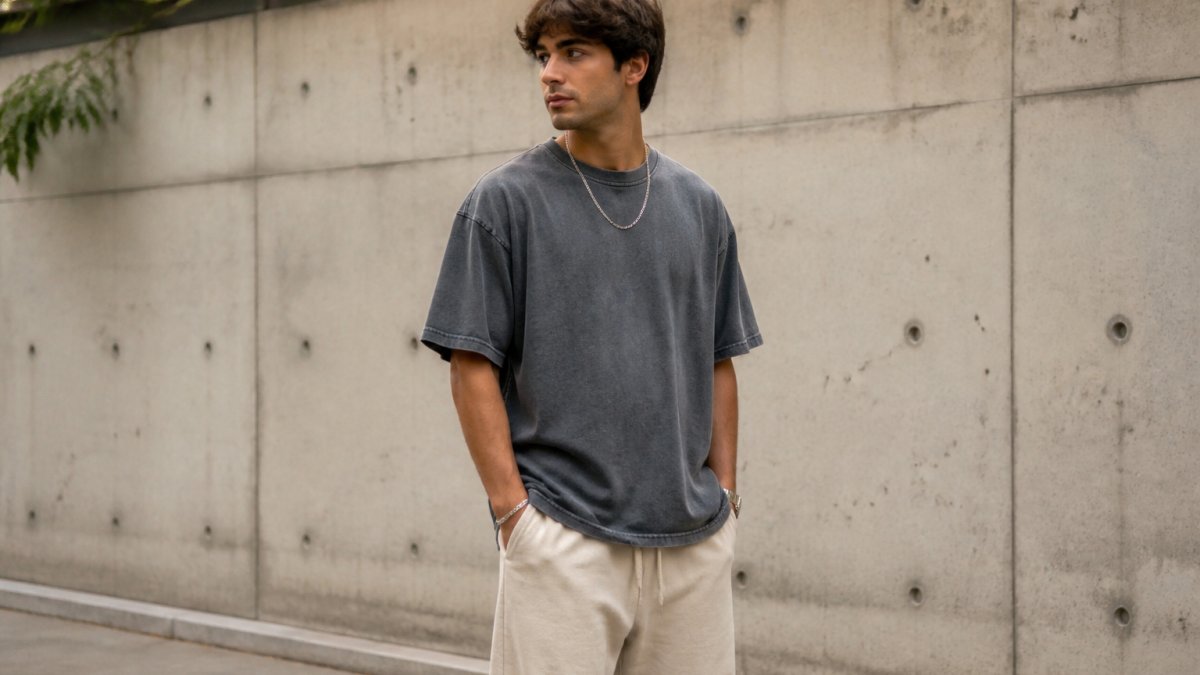
222 Oversized T-Shirt | Celestial Vintage Washed Tee →
Boxy cuts
A boxy tee relies on a straight side seam and a hem near the hip bone, and heavyweight cotton keeps that line from collapsing into an A-shape after washes. Pair it with a straight or relaxed bottom, wide-leg denim, pleated trousers, relaxed chinos, so top and bottom share the same vertical line. Avoid skinny bottoms; the contrast reads as costume.
Oversized and drop-shoulder cuts
Oversized fits are where weight matters most. A lightweight oversized tee stretches at the shoulder seam and sags at the hem, turning an intentional fit sloppy; a 240-280 GSM tee holds the drop-shoulder line and keeps the hem standing away from the body. Balance the volume with tapered or fitted bottoms, heavier fabric also won't creep up the arm the way lighter fabric does.
Cropped cuts
Cropping removes fabric and some of the weight advantage. A cropped heavyweight tee still works because the remaining body holds its shape, but the cut needs a higher GSM to compensate for the shorter length. Pair it with high-rise bottoms and check for a sturdy hem stitch, a cropped hem takes more stress than a standard one.
Longline and layered cuts
Longline tees depend on a hem that falls straight and stays there. Heavyweight cotton delivers that but adds bulk under a jacket: layer a longline tee under an overshirt or bomber in 200-240 GSM rather than 300+ so layers sit flat. If the tee is the outer layer, go heavier and let the hem do the work.
Styling rules that hold across all four
- Let the fabric set the volume, then balance it. Structured top, fluid or tapered bottom. Fluid top, structured bottom. Two structured pieces at once read as armor.
- Keep accessories proportional. A heavyweight tee has visual mass; delicate chains and small jewelry sit better against it than chunky pieces that compete with the fabric.
- Use color to manage heat and visual weight. Light colors in summer, dark or tonal outfits in cooler months. A black heavyweight tee with black denim reads as one continuous shape; a cream tee with earth tones reads softer.
- Layer with intention. A heavyweight tee under an open shirt or unbuttoned overshirt holds its shape and prevents the bunching lighter fabrics create, build visible, intentional layers rather than hiding under shapeless pieces.
If your tee carries a meaningful design, like the 222 or 11:11 celestial pieces from 12:12, let the graphic be the focal point. The fabric's structure keeps the print flat and readable, so simple styling, minimal jewelry, neutral bottoms, one strong shape, keeps attention on the intention rather than the outfit.
Cotton T-Shirts for Hot Weather: Weight vs Breathability
The tension between weight and breathability is real: heavier cotton holds more heat. But the solution isn't always lightweight fabric, it's the right heavyweight construction.
A loosely knit heavyweight cotton actually breathes better than a tightly knit lightweight one.
Color matters in hot climates: light colors reflect heat while dark colors absorb it.
Fit influences breathability too.
Most people overestimate how much weight affects temperature.
The Trade-Offs: When Heavy Cotton Isn't the Answer
Heavyweight cotton excels in most situations, but it's not universally superior, intentional fashion means matching material to context.
Cost is the first trade-off.
Warmth is a legitimate concern in genuinely hot climates.
Packability matters for travel: heavyweight fabrics take up more luggage space and weigh more.
Vintage-washed effects work better on heavier fabrics, though the wash adds cost and complexity.
Personal preference ultimately matters. Some people prefer how lightweight fabrics feel against the skin, even at the cost of durability.
Heavy cotton is better for streetwear silhouettes because it delivers the structure, durability, and intentional presence that defines premium streetwear. The 222, 11:11, and 777 oversized tees are crafted to hold their shape and maintain their spiritual significance as part of your daily practice.

Frequently Asked Questions
What is the difference between heavyweight and lightweight T-shirts?
Heavyweight T-shirts typically measure 6.0 oz or higher in fabric weight and feature a denser weave that creates structure and holds its shape. Lightweight T-shirts fall below 5.5 oz and offer more drape and breathability. Heavy cotton resists stretching and sagging over time, making it ideal for oversized streetwear silhouettes, while lightweight fabrics move and conform to the body more easily. For streetwear, heavy cotton maintains the intentional, structured look you're after.
How does heavyweight cotton change a T-shirt's silhouette?
Heavy cotton holds a more structured oversized shape because the dense weave and thicker yarn resist stretching and sagging. This creates clean lines and maintains the intended silhouette wash after wash. Lightweight fabrics drape and conform to the body, which can collapse an oversized fit over time. For streetwear that relies on intentional proportions, like the relaxed, effortless look of vintage-washed oversized tees, heavy cotton is essential to keeping the silhouette intact.
Are 100% cotton shirts good for hot weather?
100% cotton absorbs moisture and allows air circulation, making it suitable for warm conditions. However, fabric weight matters. Midweight cotton (5.5-6.5 oz) balances breathability with durability and print clarity, while heavyweight cotton (6.0+ oz) offers superior durability and shape retention but sacrifices some breathability due to its denser weave. For hot weather streetwear, midweight 100% cotton delivers comfort without compromising the structured silhouette that defines intentional style.
Do heavyweight T-shirts hold their shape better than lightweight ones?
Yes. Heavy cotton's denser weave and thicker yarn resist stretching and dimensional change through frequent washing and wear. Lightweight T-shirts are more prone to sagging and losing their original fit because the thinner fabric relaxes more easily. If you invest in a structured oversized silhouette, especially a vintage-washed piece designed to feel intentional from day one, heavy cotton ensures that shape and structure survive repeated wear and washing, protecting your investment in quality apparel.